what you need is expensive; what you want is cheap; it's getting worse
It's end-of-year. Dave's boss calls him into their office and gives him a 4% raise. Later, the benefits package comes out. Dave does the math. His family's medical bills just got bigger. He looks at his kids' college tuition; his raise didn't close the gap. An accident just put a hole in the drywall next to the TV; do you know how much it costs to get that patched?
Dave got a raise larger than inflation, but he didn't catch up. He feels like he just keeps falling further behind. But a larger TV is cheaper than ever and will hide the hole in the wall, so he's got that going for him, which is nice.
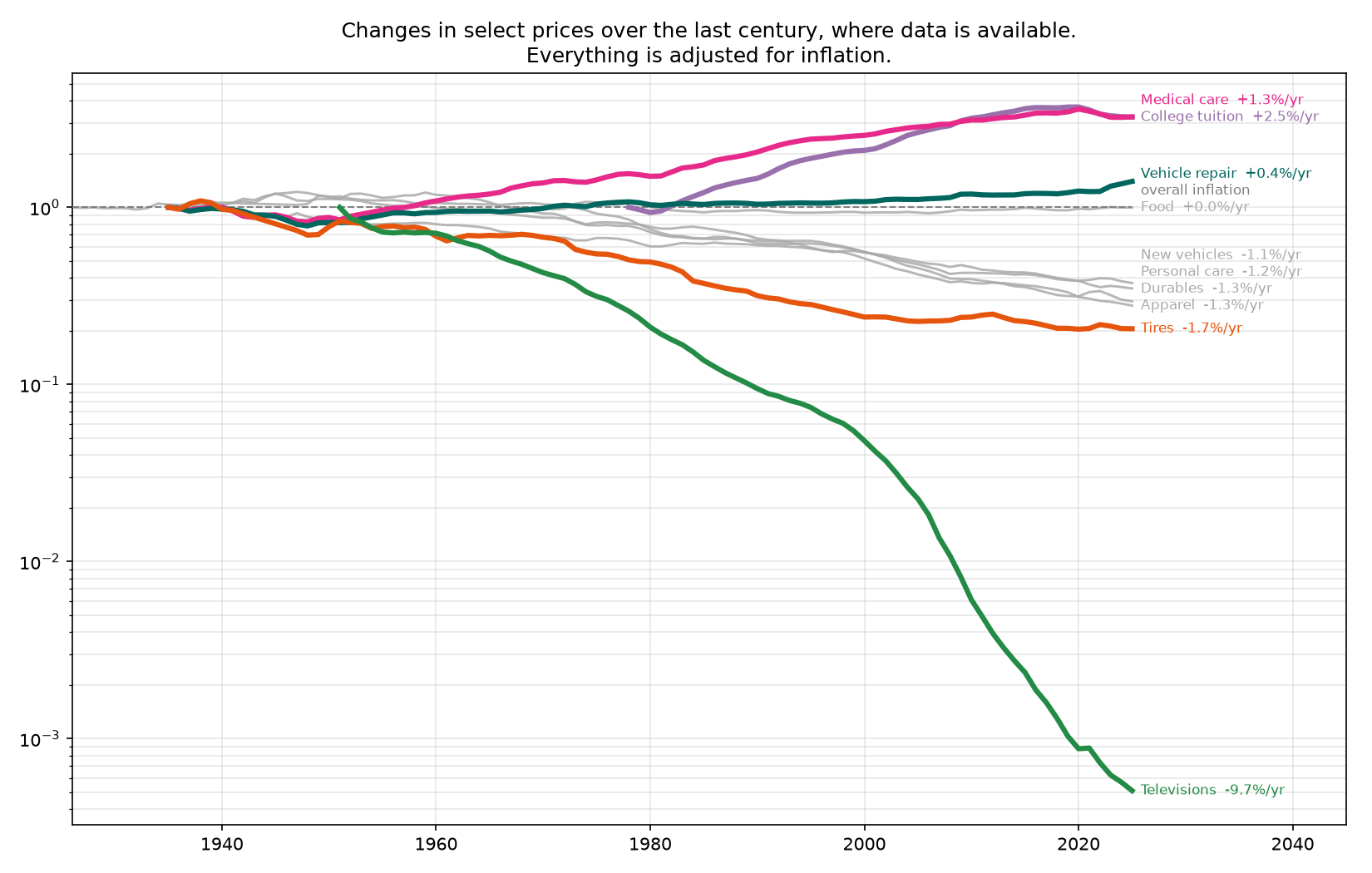
How some prices have evolved over the last century.
I've been staring at this graph1 on and off for a long time. A few weeks ago, I learned about Baumol and the more I think about it, the more important it feels to connect the dots. That conviction led to this piece. The affordability crisis is a big deal, and it's partly driven by Baumol cost disease. We have a real opportunity to improve it, but there's also a big risk that we do it wrong and make it worse. Allow me to explain.
productivity, baumol, affordability, worse off
productivity
We used to plow fields, spin yarn, and haul water from a well, all by hand. Now we have tractors, textile mills, and indoor plumbing. When labor productivity grows, the same work requires less effort.
baumol
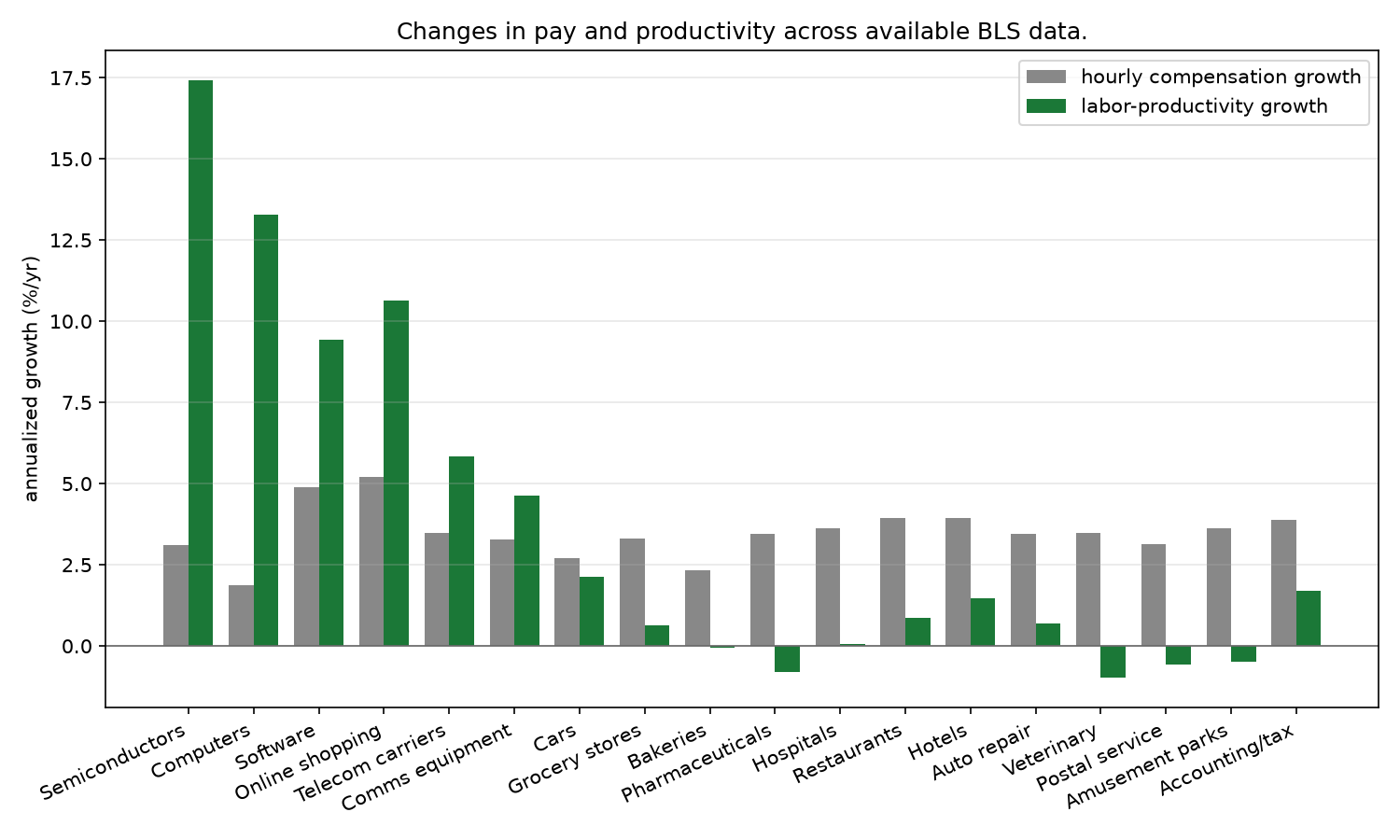
If someone's productivity goes up, there's some combination of two effects: the value of their labor goes up, and the per-unit labor cost of their product goes down. People can change jobs, and so jobs with flat productivity also see wage increases. A productivity increase in one part of the economy increases per-unit labor costs in another part of the economy. This is called Baumol cost disease.2
Wages went up across the board but productivity was very uneven.
affordability
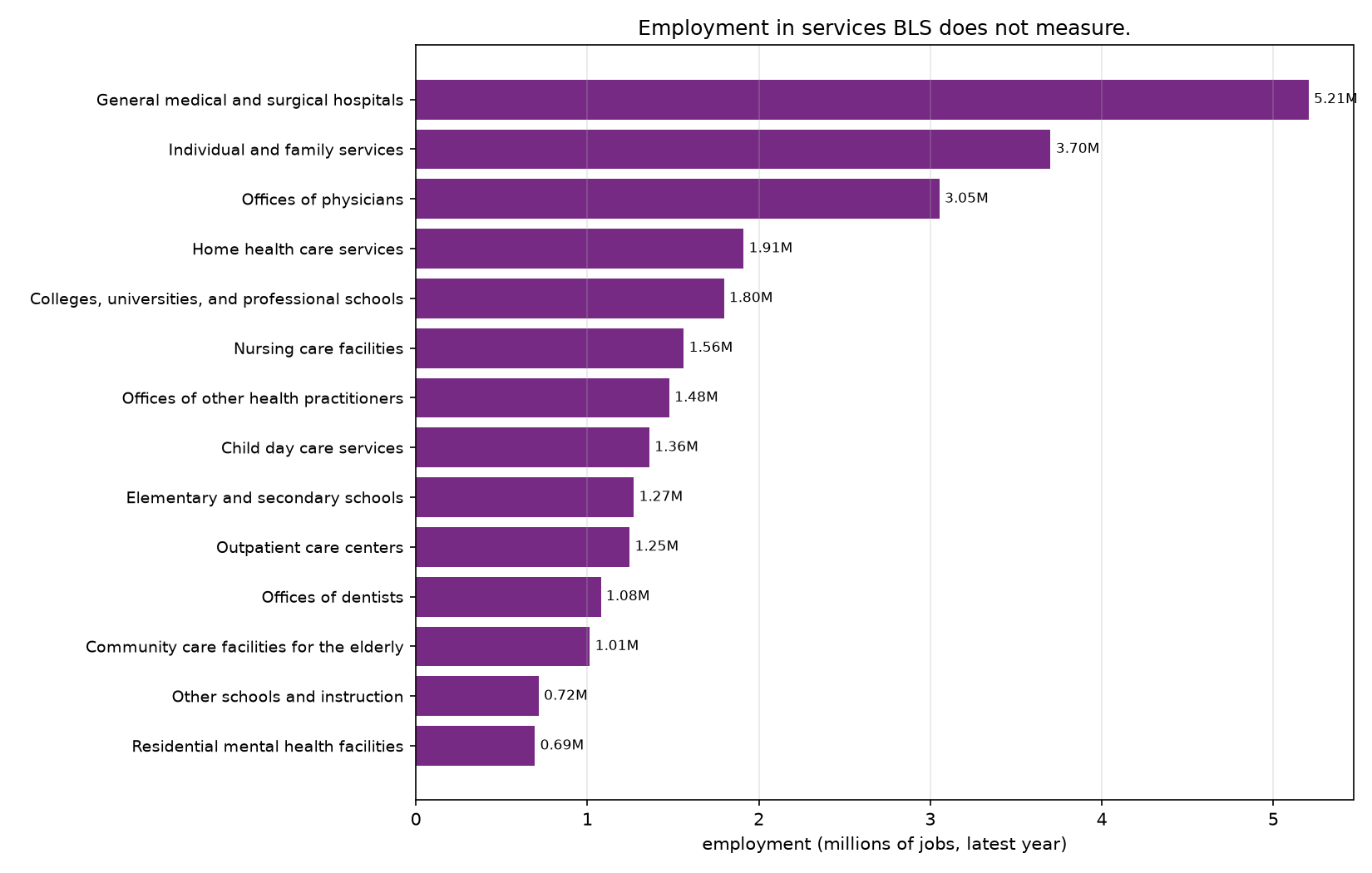
Measuring productivity can be difficult, so much so that the BLS doesn't even attempt in some cases. Compare these jobs to the products with rising prices in the first chart:
The Bureau of Labor Statistics (BLS) considers the productivity of the jobs in this graphic unmeasurable.
That's not direct evidence for my argument, and my argument doesn't rely on it. But it does add color. It's not a coincidence that these fill Dave's budget.
Let's look at healthcare. Baumol cost disease does not explain why healthcare costs twice as much in the USA as in Canada. But when you consider that healthcare costs have risen in every rich country in the world, for decades, the productivity component starts to come into focus. Helland and Tabarrok's book, which has an amusing title Why Are the Prices So Damn High?: Health, Education, and the Baumol Effect,3 finds that the Baumol effect is a major component in the US healthcare market.
worse off
I have a bold claim: it's possible for a worker to be worse off after their wages rise, if their wage rise is driven by Baumol responding to productivity gains concentrated in already high-productivity jobs.
First: there is no easy "just adjust by inflation" response, because the inflation basket is skewed toward high-income budgets; what matters is whether Dave's wages rise faster than the price of the things he buys. But more interestingly --
Before I can ask if Dave is better off, I need to ask if the workers in the job where the productivity increase landed, are better off. Here's a hypothesis: it comes down to whether wage of a job x number of that job increases or decreases after the change. Zoom out. Now it depends on the extent to which induced demand picks up the slack, when the amount of effort it takes to produce a set number of products, goes down.
My guess is that on average, high productivity jobs correlate with products that have already saturated the market, and low productivity jobs correlate with products that would have induced demand if their prices fell. You aren't going to buy 4 more TVs because the price falls another 80%, but there are people who go without healthcare because they can't afford it.
So if the productivity gain lands in a place where people have been priced out by Baumol cost disease, then everyone is better off. If it lands in a place where productivity was already high and the product space was already saturated, then we're in the space where my argument lives.
And so, Dave can't afford to patch his drywall even though he got a raise, because healthcare workers also got raises, his kids' future professors are projected to get raises, and the drywall repair company gave their workers raises. In our story, all those raises happened because productivity increased in a place it is already high. If that productivity increase had happened in e.g. healthcare instead, then Dave's costs would have gone down, instead of up. And it does, some years.4 But in general, the trend seems to be toward compounding productivity and thus unaffordability.
Is Dave the median person in this economy? Or is it only the worst-off who are affected this strongly? Where is the threshold at which Baumol's cost disease makes workers worse off even as they receive a real wage increase? I have two responses:
The worst-off matter.
There's no law that prevents the threshold from reaching and even passing the median worker.
the sort
Let's talk about the future.
Imagine a list of all the jobs in the economy, and lists of all the skills in each job.5 Next, add in numbers for how many people work each job, what the people are paid, and the portion of their time they spend doing each skill. Now, do the math to come up with how much money each skill is worth / costs, across the economy.
Now you have one big list of human skills, with dollars attached.
MIT's Iceberg Index looks at that list and measures the overlap with AI capabilities. As of June 2026, the dollar-weighted overlap is 11.7%. This doesn't include the work to integrate those tools with existing work environments and it doesn't include capabilities which may be developed in the future.
My question: How would you sort the list of human skills to make it so you can take the next one off the top, and that tells you which capability to develop or deploy, next?
I can think of two sorts, and they have very different effects.
easy sort
The first sort is about minimizing development risk and capital expenditure.
A prototype is built quickly, and as soon as it works, it's launched. New features usually flop, but that's ok; they're a dime a dozen. One sticks. Usage explodes overnight. "Product market fit!" is heard in some backroom. Competitors swarm. The first mover and the competitors work around the clock to try and add features. Each capability developed pushes the rest of the capabilities from that job higher up in the sort. (A feedback loop.6) There is no moat, nothing that keeps market share; there is only the race to keep the recurring revenue.
Productivity compounds where it already is. The Baumol effect still works, driving wages up across the board. Baumol's cost disease is on full display: low-productivity jobs and high per-unit labor costs dominate the economy more than ever. The affordability crisis worsens, for all the reasons described in the first section, compounded by the easy sort focusing each next round of productivity gains on already highly productive jobs.
deep sort
If the first sort is about minimizing risk and capital deployment, the second sort is about deploying capital to maximize return. It starts by identifying the largest costs to society, evaluating them for feasibility, and then diving in with deep expertise and a commitment to solve them. It embraces complex regulatory environments and builds relationships with the existing workforce. All of this turns into the type of moat that keeps market share and leads to solid investor returns.
The easy sort might produce a tool to make it faster to build a slide deck, but the deep sort might produce a realtime patient data tracking system that automates paperwork while double-checking treatments; such a system would not only need to be HIPAA and PSQIA compliant, but would also need to be developed for and with nursing staff. (For those unaware, PSQIA established a voluntary reporting system that's designed to aggregate, study, and learn from medical errors and near misses, without fear of litigation.)
Productivity growth is concentrated into parts of the economy that suffer the most from Baumol's cost disease. Wages don't move much, but prices fall. The affordability crisis softens and induced demand causes discretionary consumption to rise, rewarding the investment.
the mix
A mix of the easy and deep sorts will happen naturally, but I fear the easy sort may dominate. It should not. I argue that the deep sort produces more profits long-term, while strengthening rather than hollowing out the working class. The easy sort chases easy markets with no moat; returns get competed to zero. The deep sort attacks the largest costs in the economy and builds a moat. Bigger pie + retained share = more profit.
If the deep sort produces more profits, why do I worry the easy sort will dominate?
The easy sort is cognitively easier. The deep sort requires interdisciplinary work. Very few people actually understand more than one discipline very thoroughly, and few of those are at the top of any of the disciplines they understand thoroughly. Even the project management is harder when the project is interdisciplinary. So I claim that an obviously more profitable path could exist and few will find it because they don't know to look for it. That's part of what I'm doing here: I'm telling technologists to look for it. And then, hire for it.
To succeed at the deep sort, you need sustained, disciplined capital spend. That's almost the opposite of how high profile startups operate. So there's a cultural gap as well.
The short-term-ism present in the easy sort also vibes with what I've seen over my career, so part of this is my bias showing. I would love to be wrong, here. Please tell me I am.
dave
Dave has a brand new 65" TV hiding a hole in his wall. With the deep sort, fixing the actual hole in the wall may end up as affordable as that TV.
To get there, we're going to need real movement on robotics, and that's the topic of my next piece.
Though this piece emerged out of reflections on Mark Perry's famous "Chart of the Century" visual ("Chart of the Day... or Century?," AEI Carpe Diem (blog), July 12, 2019, https://www.aei.org/carpe-diem/chart-of-the-day-or-century-2/), I am skeptical of Perry's explanation that this is driven by government involvement in the rising-cost markets.↩︎
William J. Baumol and William G. Bowen, Performing Arts: The Economic Dilemma (New York: Twentieth Century Fund, 1966); William J. Baumol, The Cost Disease: Why Computers Get Cheaper and Health Care Doesn't (New Haven: Yale University Press, 2012).
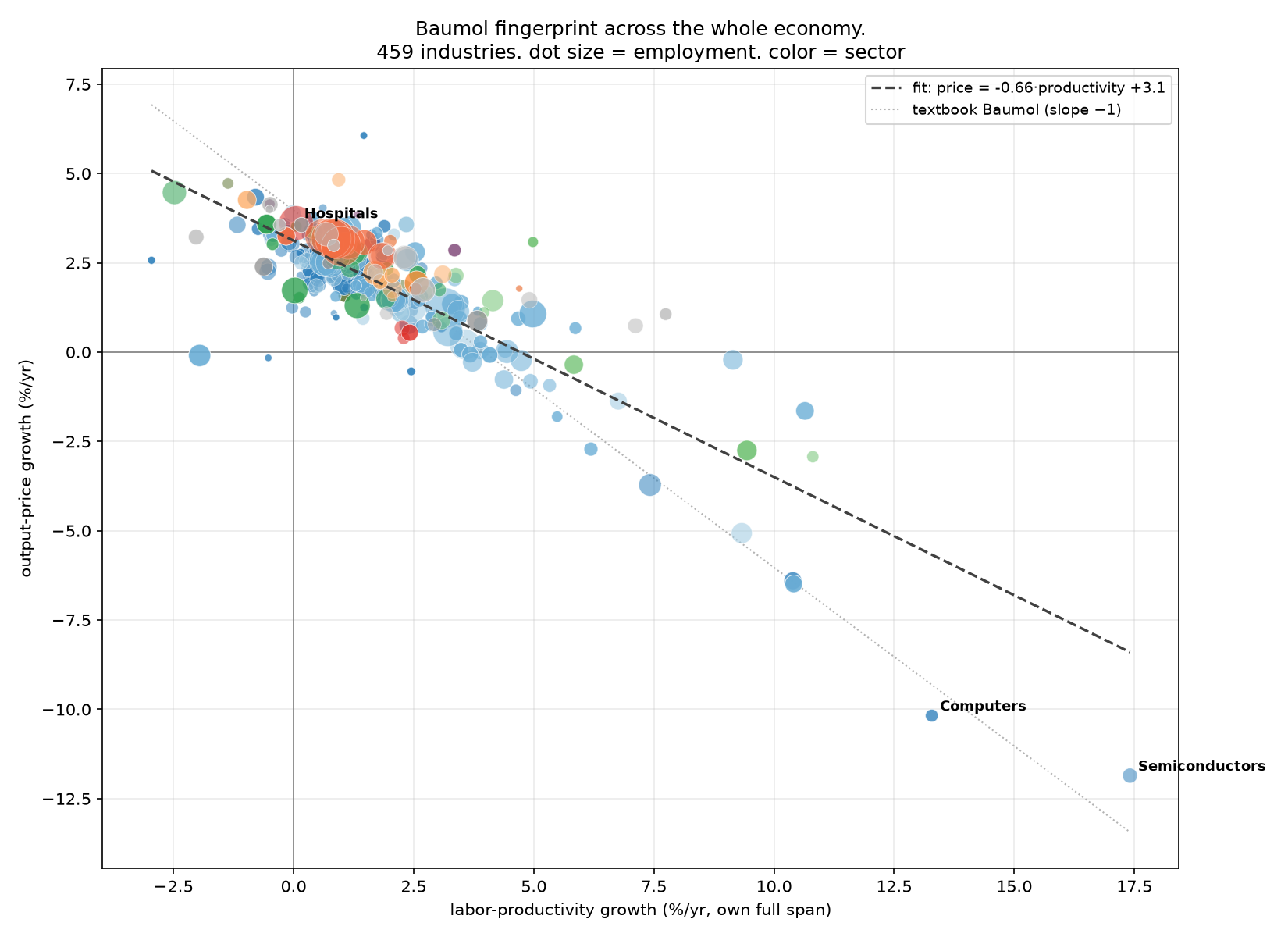
I reproduced the Baumol effect during the research phase of this piece.
The effect is weaker than the slope=-1 that textbooks would suggest but distinctly present, in a 459-industry scatterplot backed by BLS data.↩︎
Eric Helland and Alexander Tabarrok, Why Are the Prices So Damn High?: Health, Education, and the Baumol Effect (Arlington, VA: Mercatus Center at George Mason University, 2019).↩︎
Triplett and Bosworth would try to set my mind at ease. Service productivity has not been strictly flat, so cost disease may be partly a mismeasurement artifact.
Jack E. Triplett and Barry Bosworth, "Productivity Measurement Issues in Services Industries: 'Baumol's Disease' Has Been Cured," Economic Policy Review 9, no. 3 (September 2003): 23-33, https://ssrn.com/abstract=789545.
So what? Dave still can't afford to patch his drywall.
I fully grant you that service productivity has not been strictly flat. I expect that, across history, different parts of the economy will experience productivity gains at different rates. The fact that service productivity went up for a while after 1995 doesn't change today's unaffordability crisis. The Baumol effect gives us an explanation for why uneven productivity gains would drive the unaffordability of goods / services whose workers haven't seen productivity gains lately. The fact that the unevenness changes should not be a surprise.
Also, on the mismeasurement front, imagine a hedonic adjustment on healthcare. The current best treatment for a heart attack may have a much higher success rate than 20 years ago, and you may pay more for it. That's great, unless of course you can't afford it in the first place. Cost-decreasing productivity growth is still critical for workers whose budgets are full of essential services.↩︎
The skills-not-jobs approach descends from the task framework.
David H. Autor, Frank Levy, and Richard J. Murnane, "The Skill Content of Recent Technological Change: An Empirical Exploration," Quarterly Journal of Economics 118, no. 4 (2003): 1279-1333.↩︎
It's worth noting that Acemoglu also found a feedback loop in his work in "Directed Technical Change", though in his analysis the sign could be either positive or negative.